How to Choose the Right Internal Accounting Services for Your Business
- Internal Accounting Services

- Aug 12
- 10 min read
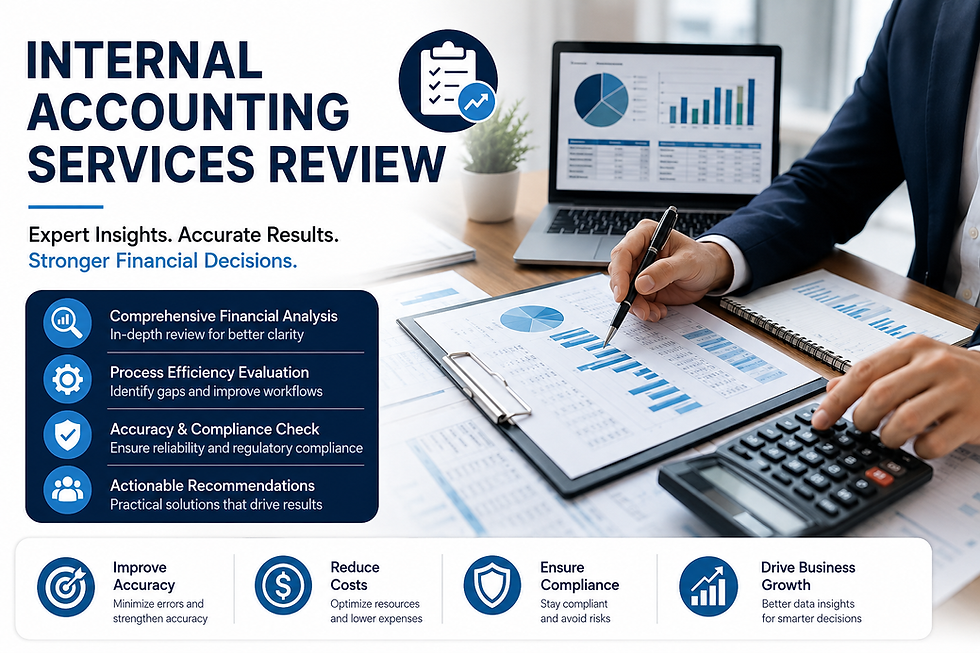
Choosing the right financial support is one of the most important decisions a business can make. Accurate bookkeeping, timely financial reporting, expense management, payroll coordination, budgeting, and financial analysis all contribute to better business performance. This is why many organizations consider professional internal accounting services to strengthen their financial processes and maintain better control over their records. The right internal accounting services can help a business organize financial information, reduce administrative pressure, improve reporting accuracy, and support informed decision-making. However, not every accounting service provider offers the same level of expertise, technology, communication, or flexibility. Businesses should therefore evaluate their requirements carefully before choosing a provider. Whether you operate a small business, growing company, or established organization, understanding what to look for in internal accounting services can help you make a practical and cost-effective decision.
Understand Your Business Accounting Requirements
The first step in choosing internal accounting services is understanding what your business actually needs. Every organization has different financial processes, transaction volumes, reporting requirements, and compliance responsibilities. Start by reviewing your existing accounting operations. Determine whether you need assistance with bookkeeping, accounts payable, accounts receivable, payroll support, bank reconciliation, financial reporting, budgeting, tax preparation support, or management reporting. Some businesses may only need basic accounting assistance, while others require comprehensive internal accounting services covering multiple financial functions. Clearly defining your requirements makes it easier to compare providers and avoid paying for unnecessary services. Consider your current workload, number of monthly transactions, accounting software, number of employees, business locations, and expected growth. A provider that understands these factors can design internal accounting services that are better suited to your organization.
Evaluate the Experience of the Accounting Service Provider
Experience is an important factor when selecting internal accounting services. A provider with relevant business experience is more likely to understand common accounting challenges and develop efficient processes. Look for an accounting service provider that has experience working with businesses similar to yours. Industry knowledge can be especially useful because different industries may have different revenue models, expense structures, reporting requirements, and financial workflows. Ask potential providers about their experience with businesses of your size and complexity. You can also ask how long they have been providing accounting services and what types of financial functions they commonly manage. Experienced internal accounting services should go beyond recording transactions. The provider should understand how financial information can be organized and presented to help management make better decisions.
Check the Range of Internal Accounting Services Offered
Before making a decision, carefully review the services included in the provider's package. Comprehensive internal accounting services may include several functions designed to keep business finances organized. Common services may include:
Bookkeeping and transaction recording
Accounts payable management
Accounts receivable support
Bank and credit card reconciliation
Payroll accounting support
Financial statement preparation
Budget preparation and monitoring
Cash flow reporting
Expense tracking
Management reporting
Financial data organization
Accounting software support
Not every business needs all of these services. The goal is to find internal accounting services that match your current needs while providing enough flexibility to accommodate future requirements.
Consider Accounting Technology and Software Expertise
Modern accounting relies heavily on technology. When evaluating internal accounting services, determine whether the provider is comfortable working with the accounting software your business currently uses. Ask whether the provider has experience with cloud-based accounting platforms, payroll systems, invoicing applications, expense management tools, and reporting software. Strong technology skills can improve efficiency and reduce manual errors. You should also consider how the provider handles data integration. If your business uses multiple financial applications, internal accounting services should be able to establish organized workflows between those systems where appropriate. Technology should support accounting processes rather than make them more complicated. A reliable provider should be able to explain its technology approach clearly and help your business maintain organized financial records.
Review Data Security and Confidentiality Practices
Accounting involves sensitive business information, including financial statements, invoices, employee payroll information, banking details, and transaction records. Security should therefore be a major consideration when selecting internal accounting services. Ask potential providers how they protect financial information and control access to accounting records. Find out whether they use secure systems, user permissions, authentication controls, backups, and appropriate data protection procedures. It is also important to understand who can access your financial information and how information is shared between your business and the accounting provider. Professional internal accounting services should treat financial data confidentiality seriously. Clear security procedures can help reduce the risk of unauthorized access, accidental data loss, or inappropriate handling of sensitive information.
Assess Communication and Responsiveness
Good accounting requires effective communication. Even highly experienced internal accounting services may not be a good fit if communication is slow or unclear. Ask how frequently you will communicate with the accounting team and which communication channels are available. Determine whether you will have a dedicated accounting contact or work with different team members. You should also understand expected response times for routine questions and urgent accounting issues. Consistent communication can make it easier to resolve discrepancies, review financial reports, and address changing business requirements. A reliable accounting provider should explain financial information in understandable language instead of overwhelming business owners with unnecessary technical terminology.
Compare Pricing and Service Structure
Cost is another important consideration when choosing internal accounting services. However, businesses should avoid selecting a provider solely because it offers the lowest price. Instead, compare the value included in each service package. Determine exactly what services are covered, whether there are additional charges, and whether pricing changes when transaction volumes increase. Some providers charge a fixed monthly fee, while others may use hourly rates or customized pricing based on business requirements. Ask for a clear breakdown of the pricing structure before making a commitment. The best internal accounting services should provide a balance between affordability, quality, reliability, and scalability. A slightly higher investment may be worthwhile if the provider delivers stronger accuracy, reporting, communication, and financial organization.
Look for Scalable Internal Accounting Services
Your accounting requirements may change as your business grows. A small organization may initially need basic bookkeeping but later require more detailed reporting, payroll support, budgeting, and financial analysis. For this reason, scalability is an important factor when evaluating internal accounting services. Ask potential providers whether they can increase or adjust their services as your business expands. Scalable internal accounting services can help prevent the need to completely change providers every time your financial requirements become more complex. Consider whether the provider can support additional employees, higher transaction volumes, new business locations, additional reporting requirements, or changes in accounting technology.
Ask About Financial Reporting and Business Insights
Accounting should not only focus on maintaining records. Financial information can also help business owners understand performance and make strategic decisions. When comparing internal accounting services, ask what types of financial reports the provider can prepare. Useful reports may include income statements, balance sheets, cash flow reports, expense summaries, accounts receivable reports, accounts payable reports, and budget comparisons. Regular reporting can help management identify trends, monitor expenses, evaluate profitability, and understand cash flow. Strong internal accounting services should organize financial data in a way that makes important information easier to understand and use.
Check References, Reviews, and Reputation
Before selecting internal accounting services, research the provider's reputation. Look for customer reviews, testimonials, professional references, and other available information about the company's services. If possible, ask the provider for references from businesses with similar accounting requirements. Speaking with existing or previous clients can provide useful information about communication, accuracy, reliability, and service quality. Online reviews can also help identify recurring strengths or concerns. However, businesses should evaluate reviews carefully rather than relying on one or two comments. A strong reputation combined with relevant experience can provide additional confidence when selecting internal accounting services.
Understand the Onboarding Process
Moving accounting responsibilities to a new provider requires an organized onboarding process. Ask how the provider plans to collect existing financial records, review your accounting system, identify outstanding issues, and establish new workflows. A professional onboarding process should define responsibilities, deadlines, access requirements, reporting schedules, and communication procedures. You should also clarify how historical accounting data will be handled and how discrepancies discovered during the transition will be addressed. Well-organized internal accounting services should make the transition as smooth as possible without unnecessarily disrupting regular business operations.
Verify Accuracy and Quality Control Procedures
Accounting accuracy is essential because financial errors can affect reporting, budgeting, taxes, cash flow management, and business decisions. Ask potential internal accounting services providers about their quality control procedures. Find out how they review transactions, reconcile accounts, identify discrepancies, and verify financial reports. Regular reconciliation is particularly important because it helps identify differences between accounting records and bank or credit card statements. A provider should also have a clear process for correcting errors when they are discovered. Consistent quality control can improve the reliability of your financial records.
Consider Industry-Specific Accounting Needs
Certain businesses have accounting requirements that are specific to their industry. Retail companies, professional services firms, construction companies, manufacturers, online businesses, and nonprofit organizations may have different financial workflows. When selecting internal accounting services, ask whether the provider understands your industry's financial requirements. Industry experience can help the accounting team understand common expenses, revenue patterns, reporting practices, and operational challenges. It can also reduce the time required to explain basic business processes to the provider.
Evaluate Flexibility and Customization
Businesses should avoid choosing internal accounting services that force every client into the same process. Your accounting workflow should reflect the structure and requirements of your organization. Ask whether services can be customized. For example, you may need weekly reporting rather than monthly reporting, specialized expense tracking, customized management reports, or additional support during periods of rapid growth. Flexible internal accounting services can adapt as your business changes. Customization can also make accounting processes more useful for management.
Ask the Right Questions Before Making a Decision
Before signing an agreement, prepare a list of questions for each potential provider. Useful questions include:
What accounting services are included in your package?
How much experience do you have with businesses like mine?
Which accounting software platforms do you support?
How do you protect financial data?
Will we have a dedicated accounting contact?
How frequently will financial reports be provided?
How are discrepancies identified and corrected?
Can your services scale as our business grows?
What is included in the monthly fee?
Are there additional charges for specialized services?
How does the onboarding process work?
The answers can help you compare providers based on service quality rather than price alone.
Common Mistakes to Avoid When Choosing Accounting Services
Businesses can make several mistakes when selecting internal accounting services. One common mistake is choosing a provider based solely on low pricing. Low-cost services may not always provide the expertise, communication, or technology your business needs. Another mistake is failing to define responsibilities. Before starting a relationship, clearly establish which accounting tasks are handled by the provider and which remain with your internal team. Ignoring security practices is another potential problem. Financial data should be handled using appropriate access controls and secure procedures. Businesses should also avoid selecting services without considering future growth. Choosing scalable internal accounting services can help ensure that your accounting support remains suitable as your organization expands.
Benefits of Choosing the Right Internal Accounting Services
The right internal accounting services can provide several benefits. Organized financial records can make it easier to understand business performance and prepare reports. Professional accounting support can also reduce the administrative workload placed on business owners and internal employees. This allows management to spend more time focusing on operations, customers, sales, and strategic growth. Accurate reconciliations and regular reporting can help identify financial issues earlier. Better visibility into expenses and cash flow can also support more informed planning. Another benefit is scalability. With the right provider, accounting processes can evolve alongside the business instead of becoming a barrier to growth.
How to Make the Final Decision
After evaluating several internal accounting services providers, create a comparison based on the factors that matter most to your organization. Consider experience, service range, technology expertise, security, communication, pricing, scalability, reporting, reputation, and customization. Do not rush the decision simply because accounting support is needed quickly. Take enough time to review service agreements and clarify expectations. The right internal accounting services provider should feel like a reliable financial support partner rather than simply a company performing routine bookkeeping tasks.
FAQs About Internal Accounting Services
What are internal accounting services?
Internal accounting services are professional accounting functions designed to help businesses manage financial records and processes. Depending on the provider, these services may include bookkeeping, reconciliations, accounts payable, accounts receivable, payroll support, financial reporting, budgeting, and other accounting tasks.
How do I know which internal accounting services my business needs?
Start by reviewing your existing accounting workload and identifying areas where your business needs additional support. Consider transaction volume, bookkeeping requirements, reporting needs, payroll, accounts payable, accounts receivable, and future growth. This assessment can help you select internal accounting services that match your actual requirements.
Are internal accounting services suitable for small businesses?
Yes. Small businesses can use internal accounting services to organize financial records, reduce administrative workload, improve reporting, and gain access to professional accounting expertise without necessarily building a large internal accounting department.
What should I look for in an internal accounting services provider?
Look for relevant experience, a suitable range of services, accounting software expertise, strong communication, data security practices, transparent pricing, scalability, reliable reporting, and positive client feedback.
How much do internal accounting services cost?
Costs vary depending on the services required, transaction volume, business size, accounting complexity, and pricing model. Request a detailed proposal from each provider so you can compare services and costs accurately.
Can internal accounting services grow with my business?
Many providers offer scalable services that can be adjusted as business requirements change. Before choosing a provider, ask how easily services can be expanded when your transaction volume, employee count, reporting needs, or business operations increase.
Why are financial reports important when using internal accounting services?
Financial reports provide information about revenue, expenses, profitability, assets, liabilities, and cash flow. Regular reporting can help business owners monitor performance and make better financial decisions.
What is the most important factor when choosing internal accounting services?
There is no single factor that applies to every business. The best choice depends on your specific requirements. However, experience, accuracy, communication, security, scalability, and service value should all be considered before making a final decision.
Conclusion
Choosing the right internal accounting services can have a significant impact on the financial organization and overall efficiency of a business. The ideal provider should understand your accounting requirements, offer appropriate services, use reliable technology, protect sensitive information, communicate effectively, and provide accurate financial reporting. Businesses should compare internal accounting services based on overall value rather than price alone. Experience, scalability, flexibility, data security, quality control, and industry knowledge are equally important when evaluating potential providers. By clearly identifying your needs, asking the right questions, checking provider credentials, and reviewing service terms carefully, you can select internal accounting services that support your current operations and future growth. A well-chosen accounting partner can help create stronger financial processes, better reporting visibility, and a more organized approach to business financial management.

Comments